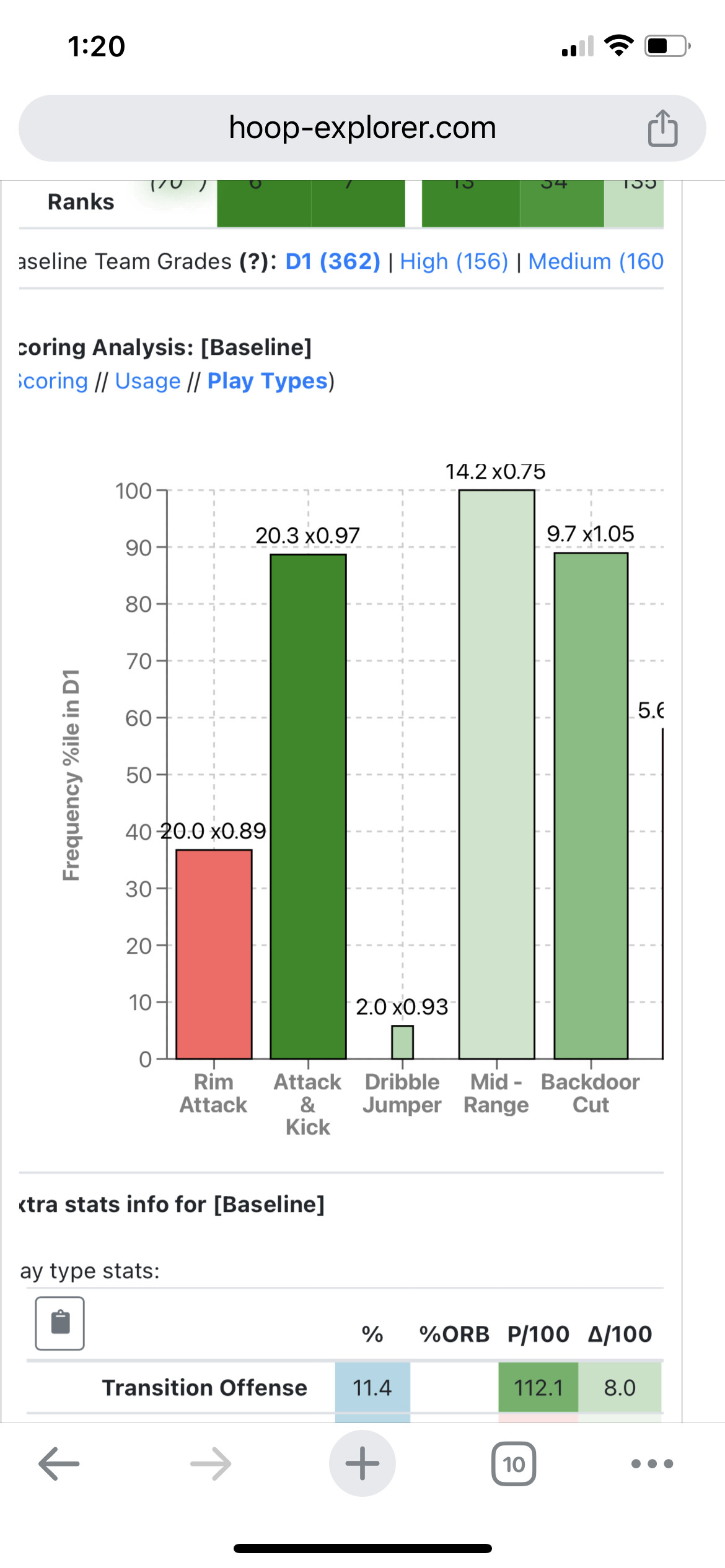
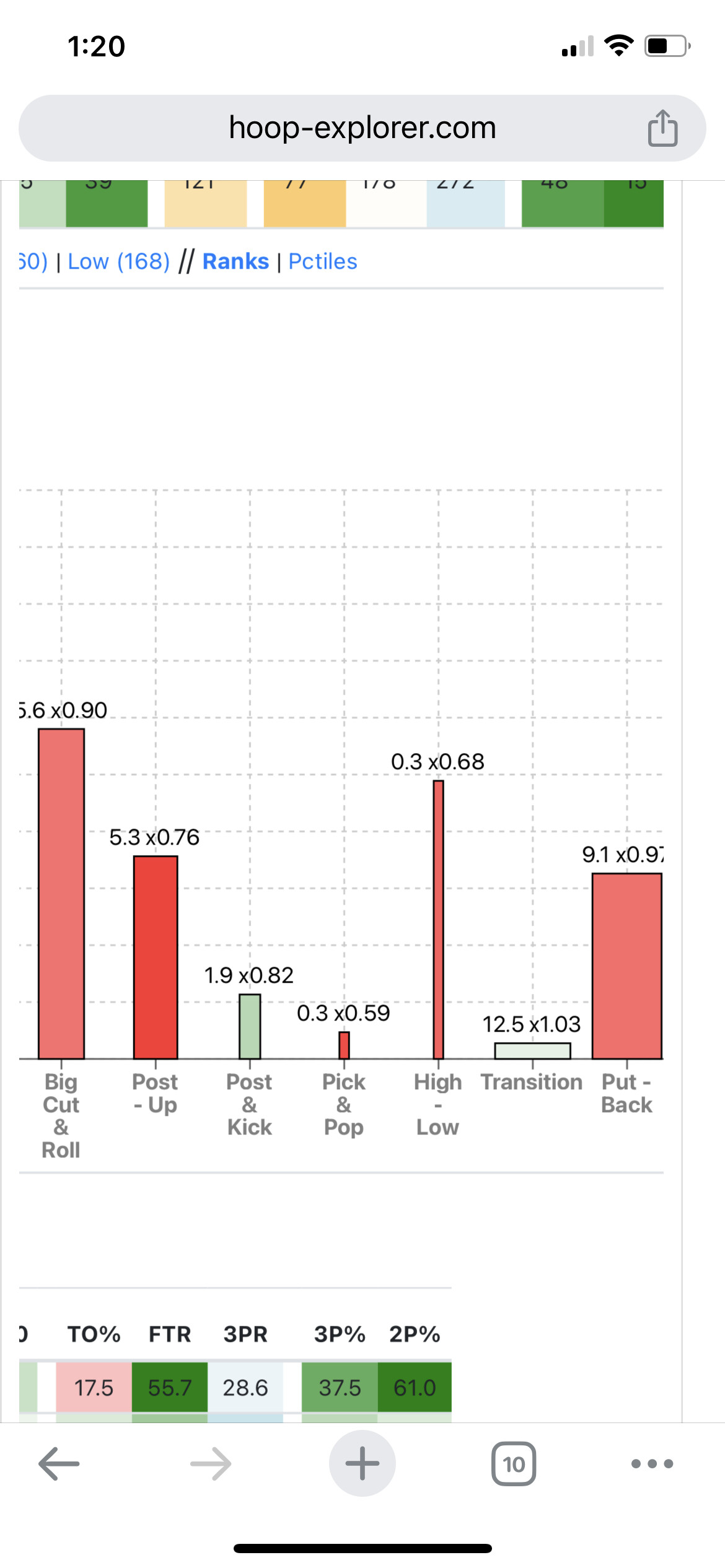
I noticed that Hoop Explorer has been getting some revamps to their site, and now by default the team analysis page shows a breakdown of what kind of play types a team tends to use on offense, and how efficient they are at them.
This first pic says that we use (relative to other D1 teams) a lot of midrange, backdoor cuts, and attacking and kick (basically taking an assisted 3P attempt). Most efficient at the attack and kick (which makes sense, most of those shots are IMac and Groves 3s), least efficient at the rim attack (drives, pull-ups, floaters).
This second pic basically shows that our bigs aren’t efficient scorers. We get like no pick and pop, but that’s partly because Groves is often categorized as a small forward rather than a frontcourt player, when he is playing with Dunn + another big.
This is interesting. The background is that the WAC has devised an approach to seeding their conference tournament based on full season resume, using a Wins-Above-Bubble type of approach with the NET as the underlying efficiency rating:
So what Bart is saying that even if you use T-Rank as the underlying efficiency rating instead for this approach, you get similar results.
Tangential to your post, but what if the NCAA did something for high major schools like rewarding high majors (or anyone) for playing better noncon schedules?
Like play with the units given out in the tourney. Bonus points for having played a better schedule. Subtract points for playing a garbage noncon. And since conferences tend to share the units (right?) then they’d be incented to make rules about noncon schedules. Bonus points for having gone to a decent mid major’s gym. Stuff like that.
NCAA needs to use the levers it has (the tourney, and related payouts, which are a big % of budget).
(My post is more focused on the “Big 12 is gaming the NET!” convos, which I think are both (a) wrong, but (b) based on a correct data point that a bunch of Big 12 coaches decided for various reasons (e.g., first year in a tough league) to play garbage non con schedules.)
I’d like to see them either discount efficiency inputs from games where there’s a large discrepancy between team quality even more than they already do with the adjustments or set a hard cap on how wins from garbage non-con type games can help you. Like if you lose or barely eek out a home win against Tarleton St. it will definitely hurt your efficiency ratings, but if you blow them out by 40 then you’ll just get the D1 average efficiency (or something like that).
That way programs can still schedule a gimme game as a tune-up, but it won’t help come tournament time.
This is a point that I think people tend to agree with in the case of a clear non-bubble team in Georgia Tech, but then not stay consistent with when they make cases for and against bubble teams.
And to @pingsc’s point about discounting inputs from mismatches, I do wonder if doing that makes prediction better or worse. To be a broken record, I think people really would be happier with better use of resume metrics for selection: Wins-Above-Bubble handles mismatches well, where the rewards and punishments are asymmetrical when teams are not evenly matched. For example, with Georgia Tech, their win against Wake was worth +0.69 WAB, which means that a bubble-quality team would only be expected to win that game 31% of the time (and correspondingly if they lost, it would be -0.31 WAB). Whereas losing at home to UMass Lowell earlier in the season was -0.89 WAB (bubble team would be expected to win 89% of the time), and would only be worth +0.11 if they had won.
Do you know, are SOR and WAB trying to do the same thing? They’re both trying to evaluate the quality of the resume rather than of the team? Are there any known conceptual differences in intent? They obviously have methodology differences but just curious if they have the same objective.
Yes they have same objective of rating the resume, without factoring in the margin of victory or defeat directly. The only differences are the underlying efficiency rating system used to define opponent strength and the framing of the rankings: WAB is “how many wins did you have compared to how a bubble-level team would be expected to have against your schedule,” SOR is “how many wins did you have compared to what a typical 25th ranked team would do against your schedule.”
I think it makes sense for the committee to use both a Team Strength metric and a Resume Strength metric. There’s arguments for both, so let them choose some of column A and some of column B, either methodically or using judgment.
What I don’t like are NET and Quads. They’re just a crude, poor man’s WAB.
NET, because:
It’s neither a Team Strength metric nor a Team Resume metric. It’s some kind of Frankenstein of the two that doesn’t mean anything understandable.
It’s opaque. We don’t know what it’s doing, so we can’t explain what it did, or tell if it’s doing it well.
Quads, because:
They use NET (see above), when given the way Quads are used, they should be based off of a Team Strength metric like KenPom
The ranges are arbitrarily defined
They’re a non-continuous step function (e.g. neutral wins against #1 and #50 are “the same”; which is why we now have Quad 1-A, but that only partially mitigates the problem)
Ultimately a Resume Strength metric already does what the Quad Evaluation Process attempts to do, except it does it with more sophistication, continuity, and consistency. It can precisely evaluate the difference between a 2-7 record against great teams, a 6-4 record against good teams, and a 10-0 record against mediocre teams, whereas the committee will never figure that out.
Phase 1: selection and seeding the top 16 teams. This should be entirely based upon a chosen resume strength metric (or an average of multiple). No efficiency or margin of victory considered. Should be all about the actual wins and loses
Phase 2: seeding the rest of the bracket. This should be mostly based upon team quality metrics while allowing for adjustments for large discrepancies in metrics
Makes the regular season more meaningful. Puts pressure on the top 20 teams to take a Wednesday night game in nowherville seriously as dropping that game will tangibly damage their tournament seeding
Could even extend it all the way to the 8 seeds if people would prefer that. Or reduce it to only the top 2 seed lines being all resume based. But imo 9 seed on should heavily incorporate quality metrics so you are less likely to end up with a Wichita State-Kentucky or Illinois-Loyola situation where a top seed is ‘rewarded’ with a second round game against a top 15 opponent. Or a UVa-UMBC situation where we were the top overall seed and got a 14 seed level opponent in the first round
I like top-16. Top 16 in the average of the current team sheet resume metrics captures most of the top 16 in the quality metrics right now; South Carolina is the outlier, where they would be a 4-seed in your approach with quality metrics in the 40-50 range.
Couldn’t it have the opposite effect? The message to the team would be “All that matters is that you win this Weds night game, you don’t have to win by a lot or look good doing it.” Against Nowheresville, who you’re tempted to not take seriously, you’d be even less dialed in that you would be under the opposite scenario.
I can think of a different reason to seed the top teams based on Resume Strength though: to incent better scheduling. Make top teams not want to schedule Nowheresville in the first place. In a Resume Strength competition, if other top teams are beating good teams, and you’re destroying bad teams, those other top teams are getting an edge on you. Whereas in a Team Strength competition, that’s not necessarily the case (and some are arguing that destroying bad teams is actually preferable).