I agree with your second point but don’t find your scenario in the first paragraph to be very realistic given the competitive nature of sports. Don’t know many high level athletes who think ‘let’s do just enough to win’
I agree, but I thought that was your premise (that we need to incent them to take that Weds night game seriously). If they’re already going to take it seriously, then NCAAT seeding is irrelevant to that Weds night game to begin with.
I’m saying the ‘you don’t have to win by a lot or look good doing it’ doesn’t really follow with human brains in high stress and high skill situations. There’s no one that threads the ‘let me focus just the right amount to win this game but not an ounce more’ needle on purpose in that environment. There isn’t a negative incentive to ‘do just enough to win’ in reality even if you could logically create one
Again I agree. I guess I don’t understand your earlier thinking then. How does seeding the top seeds by resume achieve changes within the season?
Because ‘we can’t afford to lose tonight’ is a valid motivator for human behavior? That will cause teams to be more focused. ‘We have to win by 15 tonight’ doesn’t work as well. I’m not sure what’s confusing about my posts unless I misunderstood your original post?
1 Like
We’re talking past each other somehow, I just don’t see how lol. Sounds like we’re mostly in agreement though and can leave it to Quasar to go back to stats nerdery.
1 Like
Death to the quadrant system:
2 Likes
They could fix this if (1) they used a Team Strength metric (like Torvik) to define the quads, and (2) they aligned the Home/Away/Neutral cutoff points (so that e.g. the toughest Q2 home game is comparable to the toughest Q2 away game).
These are both obvious points and they are also very easy fixes!
(They could solve even more issues by relying on continuous metrics like WAB rather than relying on 4 crude buckets, but that won’t happen. They like their committee. But they should at least give their committee accurate comparison data.)
2 Likes
Per replies, tweeter thinks the primary issue is misalignment of home/neutral/away ranges. (Ranges underestimate the difficulty of playing on the road.) Correcting that would be the easiest fix of all.
2 Likes
I thought there was talk of readjusting the quadrants or maybe there was at talk of a process to readjust the quadrants
Yes, that’s an easy fix and you could still use NET to determine the quads.
But imagine a world where they used a continuous metric like WAB…you could have a live bubble page with the bubble team’s WABs and their remaining schedule with the WAB value of each game. And then commentary would have clear takeaways like “this teams needs to win these games/avoid these losses” to earn their way into the tournament. I would never have to hear from Joey Brackets again!
(Sorry, this is my deadest horse that I like to return to every once in a while for a good thwack)
3 Likes
You’re preaching to the choir in my case. But I think for most fans, the muddy opaqueness of the committee approach is a feature, not a bug. More teams get to believe they might have a chance, and everyone gets to argue about who should be in and what metrics should matter, and of course how unfair it all is. A system with defined criteria and clear takeaways would ruin everything. 
7 Likes
Keep the committee but put a camera in there so we can see how they come up with the teams.
2 Likes
Some have had the idea of a bracket draft. Committee selects and seeds. Better seeds select their matchups and locations. Would be fun.
3 Likes
Gasaway, I think, suggested that in 2015 late in the season. It was fun because Kentucky was running roughshod over everyone but UVA was newly ascendent (and it was before we lost to UNC in the ACC tournament, probably costing the team a #1 seed), and he phrased it something like:
- Kentucky goes first and picks the #1 seed in the South as expected.
- Then Tony Bennett, picking second for UVA, says “UVA picks… the #16 seed in the South! WE’RE NOT SCARED!”
2 Likes
The only problem is that this approach would render an entire branch of science (bracketology) obsolete! It’s like tax reform - everyone would probably love it, except the people who make money off the current system, and they’re the loudest and have the largest platform.
4 Likes
5th Factor had a follow-up on the above chart. When you break into it home/neutral/away, it becomes clear that the Q1/Q2 overlap is 100% due to misalignment of the H/N/A ranges.
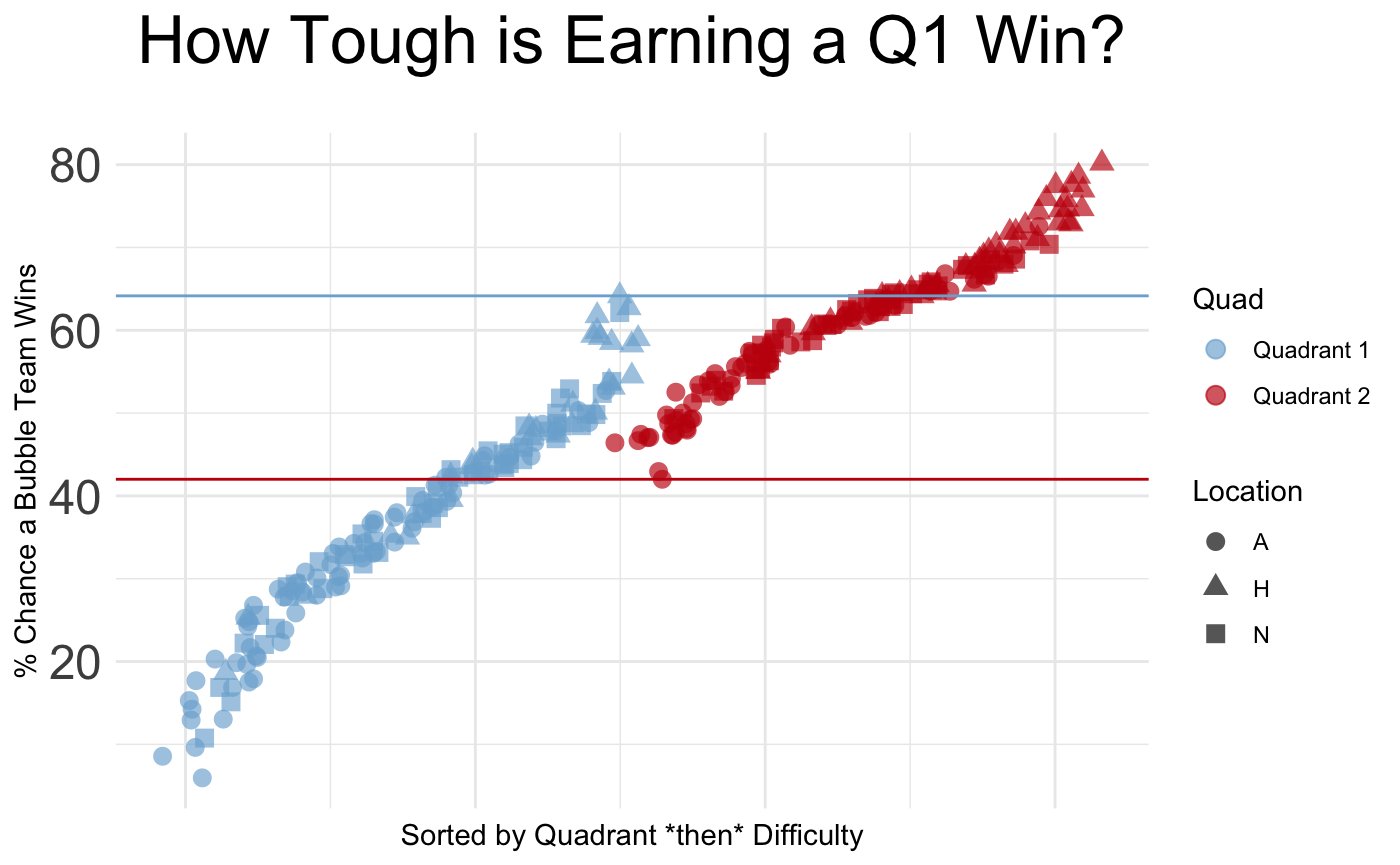
To eliminate the overlap, Quad 1 should be:
Home vs 1-20
Neutral vs 1-45
Away vs 1-90
I assume that varies from year to year, but right now we’re pretty far off.
2 Likes
It also illustrates the breadth of Quad 1. Quad 1 includes games that a bubble team has a 5% chance of winning, and games a bubble team has a 60% (!) chance of winning. Even the above “adjustment” would only tighten that range to 5-50%. It’s no wonder they’ve added a “Quad 1-A.”
6 Likes
That last part is pretty wild. I wonder what the “right” number of quads is, because it’s probably not 4.
2 Likes
But too many quads are harder for the human brain to track.
The right answer is to demote 250 teams, standardize the schedule, and just go by W/L. If that still doesn’t work go to just 15 teams and have a round robin. Champion is the team with the slowest tempo. Dunno, just spitballing here.
3 Likes